
Retaining walls in Western North Carolina do a lot more than hold back dirt. On our steep mountain lots, the right wall turns an unusable slope into a level patio, a driveable approach, or a terraced garden. The wrong wall, or the right wall built without drainage, leans, cracks, and eventually fails. We've built and repaired enough of both to know exactly where the line is.
If you're weighing a retaining wall for an Asheville-area property, here's what actually matters.
Boulder walls: natural, forgiving, at home in the mountains
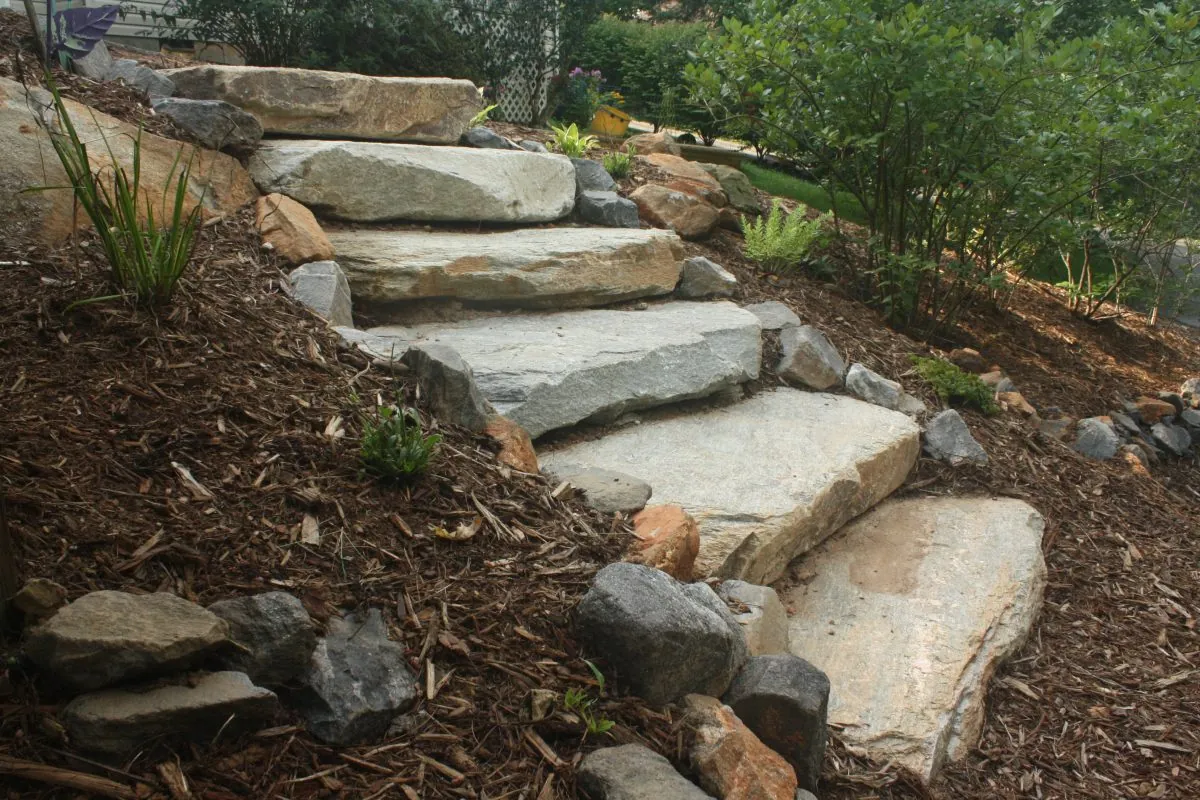
Large native boulders stacked into a wall look like they grew out of the hillside, which is why we reach for them constantly here. They handle irregular terrain well, drain freely between the stones, and age beautifully. For a naturalistic property or a garden terrace, it's hard to beat. Boulder walls shine on gentler-to-moderate grades and where the look should read as landscape rather than architecture.
Natural stone (dry-stacked and mortared): the timeless option
A dry-stacked or crab-orchard stone wall is the classic WNC hardscape, the kind of thing that still looks right fifty years later. We built a crab-orchard and flagstone stairway for a Weaverville client specifically because they wanted something permanent, not a short-term gravel fix. Natural stone costs more and takes real craft to build well, but for a signature feature near the home, it's usually worth it.
Segmental block walls: engineered and cost-effective
Interlocking concrete block systems are the workhorse for taller, load-bearing walls: think driveways, big grade changes, or anywhere the engineering has to be precise. They go up efficiently, come in finishes that look far better than they used to, and are often the most cost-effective choice for a tall structural wall. When a wall needs to do serious work, block frequently makes the most sense.
What actually drives the cost of a retaining wall
People expect a per-foot price, but the real cost drivers are:
- Height. Taller walls carry exponentially more soil pressure, so they need deeper footings, reinforcement, and sometimes engineering. A 2-foot wall and a 6-foot wall are different projects, not the same wall scaled up.
- Access. Can machinery reach the site, or does material get moved by hand? On tight mountain lots this swings the number more than almost anything.
- Drainage. Doing it right adds cost up front, and skipping it guarantees failure.
- Material. Natural stone craft costs more than block; boulders fall in between depending on sourcing.
Anyone who quotes a wall sight-unseen without asking about height and access is guessing.
The detail that makes or breaks every wall: drainage
Here's the thing most failed walls have in common: nobody dealt with the water behind them. Soil holds water, water is heavy, and that hydrostatic pressure is what pushes walls over. Every wall we build gets drainage behind it: gravel backfill, filter fabric, and a drain to carry water away. It's invisible when it's done right, and it's the reason our walls stay put. If you're comparing bids, ask each builder how they handle water behind the wall. The answer tells you a lot.
Building codes and wall height
Taller retaining walls (generally over 4 feet, though it varies by jurisdiction and load) often require engineering and permits in the Asheville area. This isn't red tape for its own sake. It's what keeps a big wall from becoming a hazard. We handle this as part of the process so you're not navigating it alone.
A retaining wall is one of those investments where cutting corners shows up years later, usually at the worst time. If you've got a slope you want to reclaim, stonework and hardscaping in Asheville is one of our core specialties. See projects we've built or get in touch and we'll walk the site with you.
Frequently asked questions
What type of retaining wall is best for a mountain property?
It depends on height and purpose. Boulder walls suit naturalistic slopes and garden terraces; dry-stacked natural stone is ideal for signature features near the home; and engineered segmental block is usually best for tall, load-bearing walls like driveway grade changes. Every option needs proper drainage regardless.
What makes retaining walls fail?
Poor drainage, almost every time. Soil behind a wall holds water, and that pressure pushes the wall over. A properly built wall has gravel backfill, filter fabric, and a drain behind it to carry water away. Skipping this is the number-one cause of leaning and cracking.
Do retaining walls need a permit in Asheville?
Taller walls (generally over about 4 feet, though it varies by jurisdiction and the load involved) often require engineering and permits in the Asheville area. Shorter garden walls typically don't. We handle permitting and engineering as part of the project when it's required.
Thinking about a project like this?
We've been designing and building landscapes across Asheville and Western North Carolina since 1997. Tell us about your property and we'll walk it with you.
Schedule a consultation or call 828-624-5136