
A lot of the outdoor living projects we get called about start with the same sentence: we built this space and we never use it. Sometimes it is the wind coming across the ridge, or the sun landing on the one spot you wanted to sit in at exactly the wrong hour, or the fact that carrying dinner out there is a three-trip operation. On a mountain lot, the reason an outdoor space goes unused is almost never the furniture.
Outdoor living is one of our core services, and on a Western North Carolina property it sits somewhere between landscaping and site work. Here is how we plan one: where it goes, what belongs in it, what a fire feature actually involves around Asheville, and the order to build it in.
Start with the hours you will actually be out there
Before anything gets drawn, we want to know when you picture using the space. Morning coffee and evening dinners are two different rooms. One wants early light and shelter from a cool breeze; the other wants shade at six o'clock and somewhere for people to stand while someone cooks.
The mountains push this further than most places. Elevation means our evenings cool off quickly even after a warm day, and the shoulder seasons here are long. That is the biggest reason fire features get used so heavily in Asheville yards. A space designed with warmth in it is a space you use in April and October, not just in July.
Site the room before you design it
Sun, wind, and the view
Walk the yard at the hour you plan to use it, more than once. West-facing seating that is glorious in October can be unusable in July, and a spot that feels sheltered on a still afternoon can be in a steady draft when air moves down the slope. That matters twice over if there is a fire in the plan, because smoke goes where the air goes and it is better to learn that before the stone is set. Views are worth chasing but not worth everything: some of the best spaces we have built face away from the long view and into the garden, because that was the ground that was flat, sheltered, and close to the door.
Distance from the kitchen door
This is the most underrated factor in whether a space gets used. If serving a meal out there means more than one trip, most people stop bothering by the second week. The fix is either to keep the space close to the kitchen or to build enough into it that it does not need the kitchen, which is where a counter, a grill surround, or a small outdoor sink earns its keep.
The slope decides the footprint
An outdoor room has to be level. A mountain lot is not. That gap is the real project, and it is why an outdoor living space here costs more than the same square footage in the Piedmont. We cut into the hill on the uphill side, fill on the downhill side, and hold the whole thing with a retaining wall before any surface goes down; our guide to choosing a patio surface covers what goes on top once that platform exists. The upside of a slope is that terracing gives you separate levels for separate purposes, so the fire circle, the table, and the grill are not competing for the same twelve feet of ground.
The fire feature: pit, fireplace, or neither
An open fire pit
A stone fire pit is the most sociable option, because people sit all the way around it. It is also the most flexible, the least expensive of the built options, and the easiest to place well; the design questions are the seating circle around it and how sheltered the spot is from wind. We built exactly that for Greg and Ashley at their West Asheville retreat, a patio and fire pit area beside the deck they already had, so the yard finally gave them somewhere to gather when they were in town.
A built outdoor fireplace
A fireplace with a chimney is a bigger piece of masonry and a different experience. It draws smoke up and away from the seating rather than into it, it anchors the space and gives it a backdrop, and it can act as a windbreak on an exposed lot. In exchange it is a real structure with a footing under it, it costs meaningfully more, and it seats people on one side rather than all the way around.
Wood or gas
Wood is what most people picture, and it is the reason a fire feels like a fire. It also means hauling and storing firewood, cleaning out ash, and checking burning conditions before you light it. Gas trades some of that atmosphere for instant on and off, no smoke drifting toward the neighbors, and no ash, and if you want a fire on a Tuesday evening without planning for it, gas gets used more often. Running the line is licensed, permitted work, so decide early: retrofitting a gas line under a finished stone patio means taking the patio apart.
What the burning rules here actually say
This surprises people who move here, so it is worth knowing before you plan an evening around a fire. Buncombe County's open burning rules are administered by the Asheville-Buncombe Air Quality Agency, and they are stricter than in much of the state. Open burning is illegal wherever public trash pickup is provided, which includes the City of Asheville, Biltmore Forest, Black Mountain, Montreat, Weaverville, and Woodfin, and inside Asheville city limits you cannot burn without a special permit from the City Fire Department.
Where burning is allowed, only natural vegetation may be burned, never household trash, treated wood, or construction material, and only on a designated burning day between 8:00 am and 6:00 pm. It is never legal to burn on an air quality action day, and both the county fire marshal and the state can ban burning outright during dry, windy stretches, which happens here most years. The Air Quality Agency runs a daily recording on 828-250-6767 telling you whether it is a burning day.
Those rules are written around burning yard debris rather than a contained fire you sit next to, and a campfire burning nothing but firewood is treated differently from a brush pile. Bans and action days are worded broadly, though, so check the county's current guidance before you light anything. A gas feature is the one option a burn ban never touches.
Outdoor kitchens: how far to take it
There is a long ramp between a grill on a patio and a full outdoor kitchen, and most people are happiest somewhere in the middle. In rough order of what gets used:
- Counter space beside the grill. The cheapest thing on this list and the one people say they would not give up. Somewhere to set a platter down changes how the space works.
- A built grill surround in stone. Turns an appliance into part of the landscape and gives you storage underneath, out of the weather.
- A sink. Genuinely useful, and the point at which plumbing enters the project. In our climate the supply line has to be built so it can be drained before the first hard freeze, which is a design decision, not an afterthought.
- Refrigeration and dedicated circuits. Worth it if you entertain often, not worth it if the space is mainly for two people and a fire.
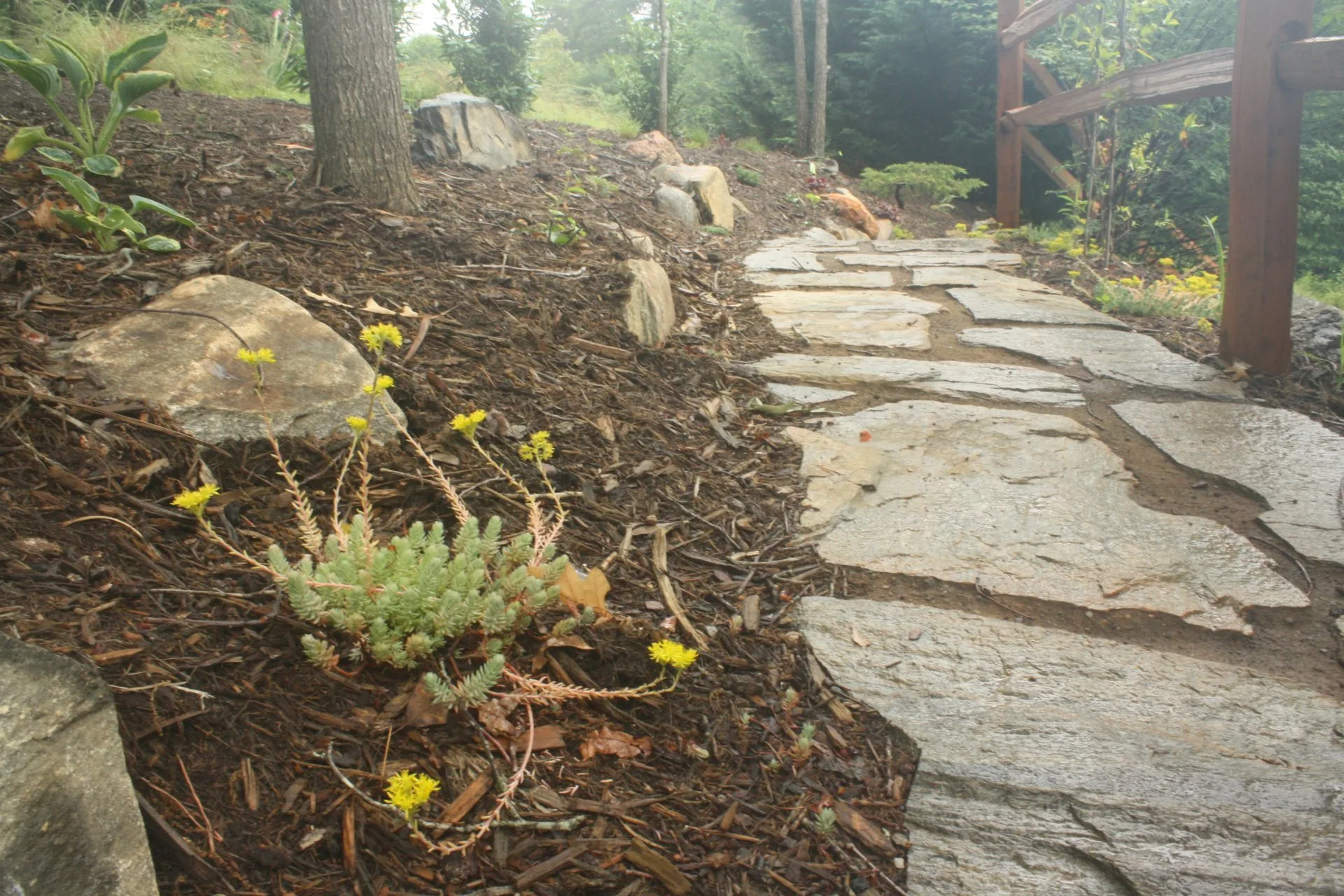
We build natural-stone outdoor kitchen sets and fireplaces, open and closed barbecues, and the walkways and patio areas that connect them, so the kitchen reads as part of the landscape rather than a metal island parked in the middle of it. Build the stonework for the whole plan and add appliances over time if you need to, because opening finished masonry later is the expensive way round.
Seating you do not have to put away
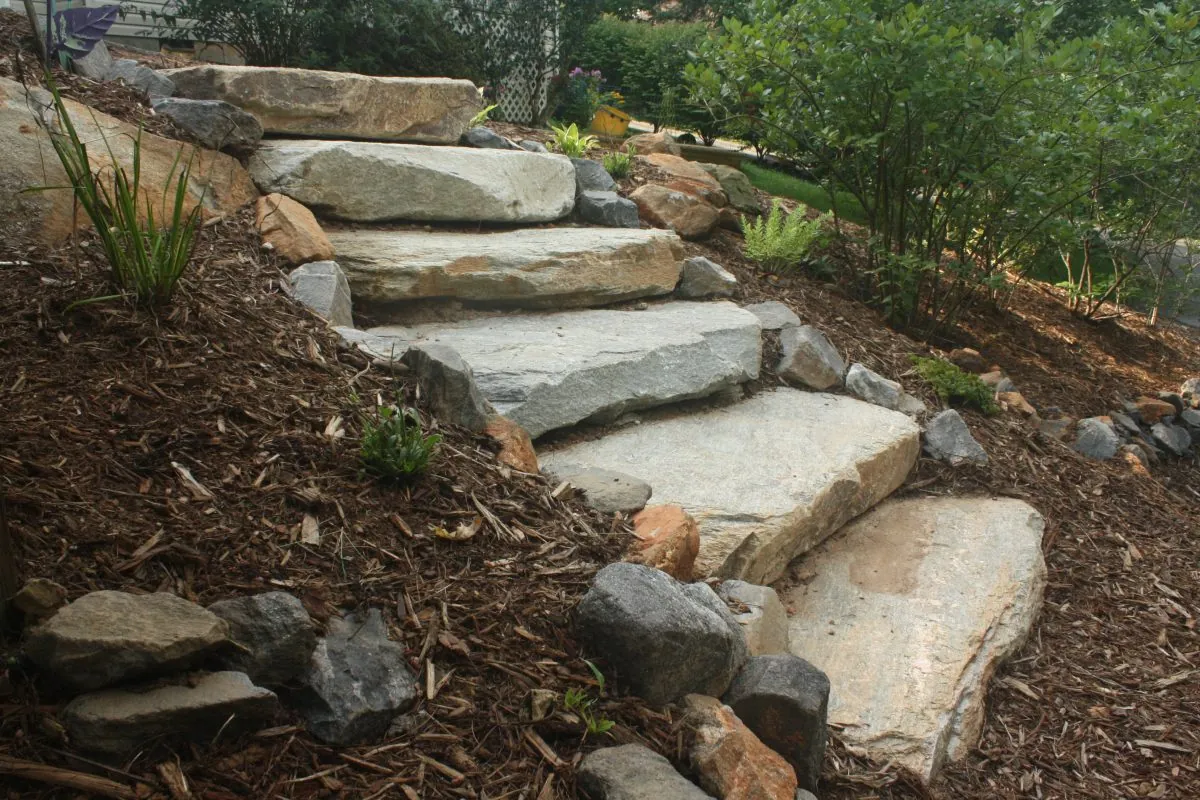
Furniture is the part everyone plans and the part that ages fastest. Built-in seating does not blow over, does not need storing in November, and does not have to be replaced in five years. A sitting wall along the edge of a terrace gives you overflow seating at every gathering and a boundary the rest of the year, and on a sloped lot that wall is often doing structural work anyway, so capping it properly turns a cost you already had into seating. The same goes for steps: our crab-orchard and flagstone stairway at Robyn and Bruce's Weaverville property was built for safe access down a steep slope, and generous stone treads like those get sat on whenever people gather.
Light, power, and the extension cord test
An outdoor room is an evening room, and in the mountains it gets dark under tree cover earlier than the sky suggests. Low-voltage lighting is the difference between a space that empties at dusk and one that holds people until ten: light the steps and level changes first, for safety, then the walls and planting for atmosphere, and keep it low and warm. The test we use for everything else is simple. If the plan involves an extension cord running out of a window, something needs to be built in, and conduit is cheap while the ground is open and expensive once there is stone on top of it.
Shelter, screening, and privacy
Two different problems get solved with structure. Overhead shelter, meaning a pergola, gazebo, or arbor, extends how much of the year and the day the space works and gives the room a ceiling. Screening is about what you can see and who can see you, and planting is usually the better answer there. It should be evergreen, or you lose the screen exactly when the leaves are down and you can see straight through to the next house, which was the brief at the Weaverville property after hurricane damage took out mature trees around a new guest house. Choose those plants with the deer in mind, because a screen browsed to bare stems is not a screen; our guide to deer-resistant landscaping covers which evergreens hold up here.
The water question that outlasts everything else
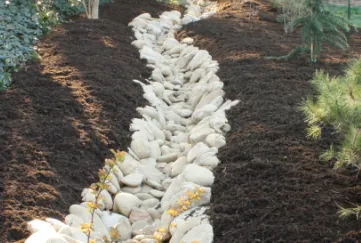
Every hard surface you add is a surface rain no longer soaks into, and on a mountain lot that water moves fast. A patio or a roofed structure is a small watershed, and if nobody plans where the runoff lands you get a soggy lawn downhill, a scoured planting bed, or water working its way toward the house. We build drainage into the space rather than bolting it on: pitch the surface correctly, catch what comes off any roof, and give the water a route that is part of the design, because a dry creek bed taking roof and patio runoff can be one of the better looking things in the yard. The options are in our guide to yard drainage on Asheville's slopes, and skipping this is the most common reason we get called back to fix somebody else's hardscape.
What actually drives the cost
We do not publish square-foot prices, because on mountain properties they mislead more than they help. What moves the number, roughly in order:
- Access. Whether machinery can reach the work. A backyard reachable only through a narrow side yard turns machine work into wheelbarrow work, and that shows up in every line.
- Grade and site work. Cut, fill, walls, and drainage. On a steep lot this is usually the biggest share of the budget and the part you cannot see when it is finished.
- Materials. Natural stone costs more than manufactured block or pavers, and it is what makes a space look like it belongs in these mountains.
- Utilities and structures. Gas, water, and electric each bring a licensed trade and a permit into the project, and a fireplace, pergola, or gazebo is a built structure with a footing, not an accessory.
The cheapest version of a mistake is the one you catch on paper. Building a level platform and its drainage once, correctly, costs far less than building the same patio twice.
Permits, property lines, and when to build
The at-grade parts of an outdoor room are usually straightforward. What triggers review is the structural work: retaining walls above a certain height, roofed structures, fireplaces and chimneys, and any gas, plumbing, or electrical work. Which rules apply depends on whether your property sits inside Asheville city limits or in unincorporated Buncombe County, and the two are administered separately with their own thresholds, so rather than take a number off a blog post, check with the permit office covering your address. We handle that as part of the project, and we would rather settle setbacks and where runoff crosses a property line on paper than in stone.
As for timing, hardscape is the least seasonal work we do. The real limits are frozen ground and saturated clay, because a base cannot be compacted in mud. That makes late summer and fall a strong stretch to build, and a space finished in autumn is ready for the following spring instead of being started then. The planting around the edges follows the normal mountain rhythm, where fall is the best window, and our guide to low-maintenance mountain landscaping covers what belongs at a patio edge.
Small yards deserve the same process, not a smaller version of it. Ben and Andrea's pet-friendly backyard is a compact in-town lot where the whole job was balancing gathering space against open lawn for their dog, and a small space laid out well beats a large one that never resolved into rooms.
We have been designing and building outdoor living spaces across Asheville, Buncombe County, and the Western North Carolina mountains since 1997. Have a look at the projects we have built, where you will also find answers to the questions we get asked most often, or schedule a consultation and we will walk your property with you and tell you honestly what it would take to make it a place you use.
Frequently asked questions
Where is the best place in the yard for an outdoor living space?
The spot that gets used is usually the one that is level, sheltered from the wind, and close enough to the kitchen door that carrying food out is one trip rather than three. Walk your yard at the hour you actually plan to use it, more than once, because west-facing seating that is lovely in October can be unusable in July. On a sloped Asheville lot the level part is the expensive part, so the site work and the retaining wall that create the platform usually decide the footprint before the design does.
Can I have a fire pit at my home in Asheville?
Buncombe County's open burning rules are administered by the Asheville-Buncombe Air Quality Agency and they are strict. Open burning is illegal wherever public trash pickup is provided, which includes the City of Asheville, Biltmore Forest, Black Mountain, Montreat, Weaverville, and Woodfin, and inside Asheville city limits you cannot burn without a special permit from the City Fire Department. Where burning is allowed it is only natural vegetation, only on a designated burning day, and only between 8:00 am and 6:00 pm, never on an air quality action day. The Air Quality Agency keeps a daily recording on 828-250-6767, and the county fire marshal bans burning outright in dry, windy weather. Those rules are written around yard debris rather than a contained fire you sit next to, but bans are worded broadly, so check the county's current guidance before you light anything. A gas fire feature is the one option a burn ban never touches.
Fire pit or outdoor fireplace: which is better on a mountain lot?
A fire pit is more sociable, because people sit all the way around it, and it is the less expensive and more flexible of the two. A fireplace is a bigger piece of masonry with a footing under it, it seats people on one side, and it costs meaningfully more, but it pulls smoke up and away from the seating, gives the space a backdrop, and can shelter an exposed site from the wind. On a windy lot, or where the space needs a wall to feel like a room, the fireplace usually earns the difference.
Do I need a permit for an outdoor kitchen or fireplace in Asheville?
The at-grade parts of an outdoor room are usually straightforward, but structural work is what triggers review: retaining walls above a certain height, roofed structures, fireplaces and chimneys, and any gas, plumbing, or electrical work. Whether your property sits inside Asheville city limits or in unincorporated Buncombe County changes which office and which thresholds apply, so check with the permit office covering your address rather than taking a number off a blog post. We handle that process as part of the project.
When is the best time of year to build an outdoor living space in Western North Carolina?
Hardscape is the least seasonal work we do here. The real limits are frozen ground and saturated clay, because a base cannot be compacted properly in mud, which makes late summer and fall a strong stretch to build. A space finished in autumn is ready to use the following spring rather than being started then, and the planting around its edges lands in the best window the mountains give us.
Thinking about a project like this?
We've been designing and building landscapes across Asheville and Western North Carolina since 1997. Tell us about your property and we'll walk it with you.
Schedule a consultation or call 828-624-5136